Water Damage Carpet Repair in Kanata
A burst supply line or a wet basement window does not usually destroy a carpet — it destroys the underpad beneath it, and then the clock starts. Kanata Carpet Pros lifts the affected area, cuts out and replaces the soaked pad, dries and treats the sub-floor, and re-stretches the same carpet back down. Done in the first couple of days, that turns a five-figure re-flooring conversation into a one-visit repair. Left a fortnight, the decision gets made for you.
- Carpet lifted rather than written off
- Soaked underpad cut out and replaced
- Sub-floor dried, treated and sealed
- Same carpet re-stretched back down
- Written scope you can give an adjuster
- Fast response on fresh leaks
Working out how bad it actually is
Three answers decide the entire scope of a water job, and you can get all three yourself before we arrive.
Where did the water come from?
Clean supply water from a burst line, a dishwasher, a fridge feed or a humidifier is the good case. Rainwater or snowmelt through a window well is usually still recoverable but arrives with grit and organics. Anything from a floor drain or a sewer line is contaminated and the carpet and pad are not coming back, however new they are.
How long has it been sitting?
Under forty-eight hours, we are talking about drying and pad replacement. Past seventy-two, with a warm room and no airflow, the pad and the underside of the carpet backing have had ideal conditions for long enough that removal is the honest recommendation rather than the profitable one.
How far did it travel?
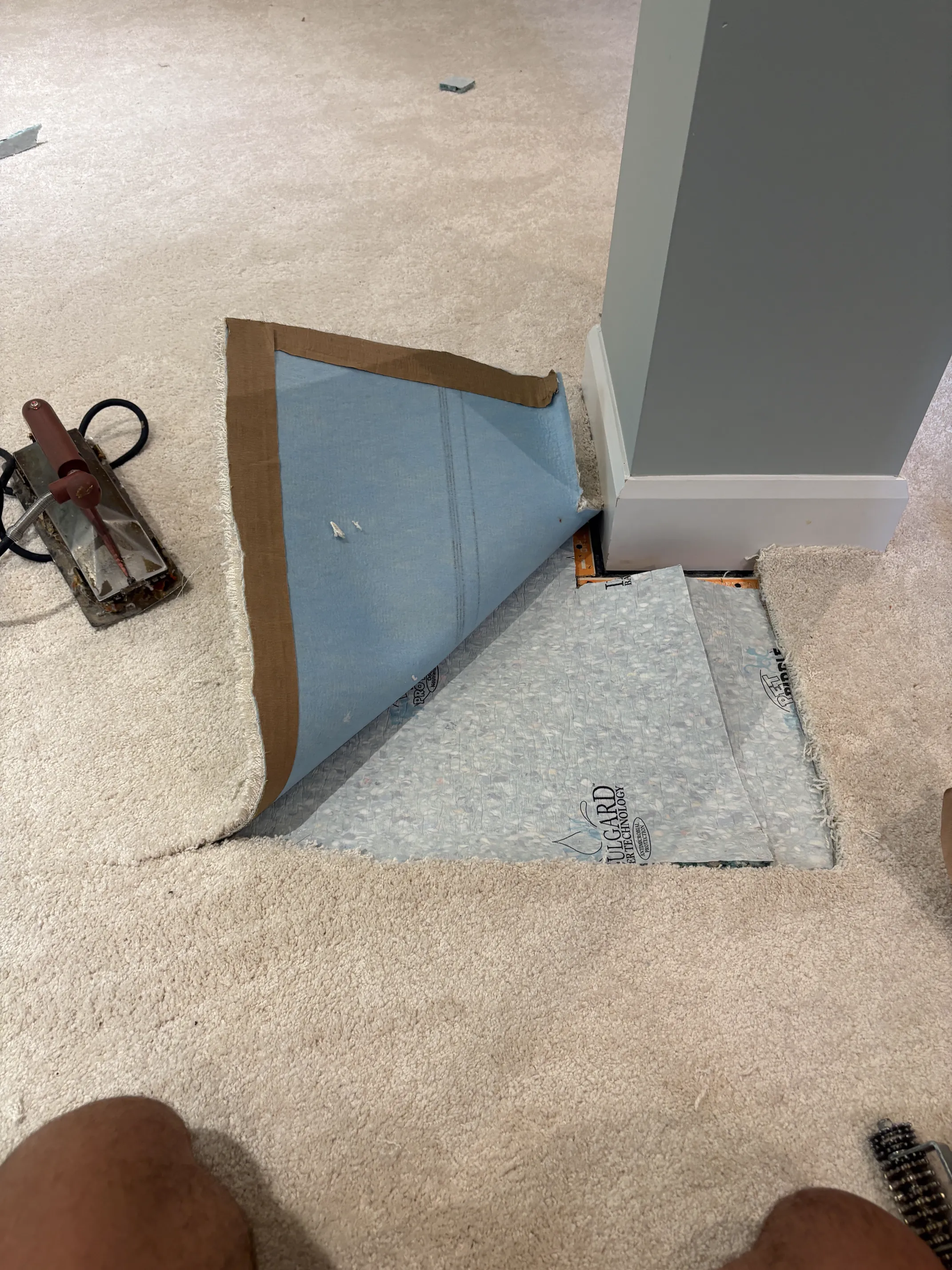
Water moves along the sub-floor further than the visible stain suggests, and it runs under walls into the next room. Peel the carpet back at the nearest edge and press the pad with your palm well outside the obvious wet patch. If it is cool and damp two metres away, the job is bigger than it looks from the doorway.
Why the underpad goes and the carpet often stays
Understanding what each layer does with water explains the whole repair, and explains why 'we dried it with fans' so often ends in a smell three weeks later.
Carpet dries, foam does not
Carpet face fibre is mostly synthetic and dries reasonably well once it is lifted and air can reach both sides. Rebond underpad is open cell foam bonded with adhesive: it absorbs many times its weight in water, holds it against the sub-floor, and will not give it up while it is lying flat under a carpet. Fans blowing across the top of an installed floor are drying the one layer that was never the problem.
A moisture-barrier pad changes the outcome
In basements we install pad with a bonded moisture barrier, and it earns its keep in exactly this scenario: a spill or a small leak stays on top of the film instead of soaking into the slab, so the recovery is a lift-and-dry rather than a replacement. It is the strongest practical argument for the upgrade.
What we put back
Replacement pad is cut to the affected area and butted to the existing pad with tape so there is no step under the carpet. Where the original pad has aged badly, we will say so — a fresh patch of springy pad under one corner of a floor with a decade-old pad everywhere else is something you will feel underfoot.
When water damage means new carpet
We would rather sell you a $400 repair than a $4,000 floor, but there are cases where a repair is simply the wrong answer and we will tell you which one you are in.
It was not clean water
Contaminated water ends the discussion. Carpet and pad both come out, the sub-floor is cleaned and sealed, and new material goes down. No amount of treatment makes a sewage-exposed carpet a floor a family should be barefoot on.
Delamination has already started
Prolonged saturation separates the carpet's secondary backing from its primary. You see it as soft rolling lumps that shift underfoot and will not stretch out. Once the backing has let go, the carpet cannot be re-tensioned and is finished regardless of how the face looks.
The smell is coming from the deck
If the sub-floor itself is stained through and holding odour after treatment, the problem is below the flooring entirely. Re-laying carpet over it seals the smell in for a few weeks and then releases it into the room every humid day. That is a sub-floor repair, and it needs doing before any floor covering goes back.
Fresh leak in a Kanata basement or main floor? Call rather than message — we prioritise wet jobs over scheduled ones. We take the same calls out to the sand-plain cottages in Constance Bay and the rural properties around Dunrobin, where a sump or a spring thaw is usually behind them.
Water damage questions
How quickly do I need to act after a carpet gets wet?
Within about forty-eight hours for clean water. Up to that point the carpet almost always survives and only the underpad needs replacing. Past it, the wet pad and the sub-floor beneath have been holding moisture at room temperature long enough that the decision shifts from drying to removing.
Does wet carpet always have to be thrown out?
No — but the underpad usually does. Carpet is a woven face you can lift, clean and dry; underpad is open foam that holds water like a sponge and never fully dries in place. In most clean-water jobs we save the carpet, replace the pad, dry and treat the deck, and re-lay the same floor.
What's the difference between a clean-water leak and a sewer backup?
Everything. A supply line, a dishwasher hose, or a melting snow pile at a basement window is clean water and the floor is usually recoverable. Anything involving sewage or a floor drain backing up is a contamination job — that carpet and pad go out, no exceptions, and the sub-floor gets sanitised before anything is re-laid.
Do you work with insurance on a water-damaged floor?
We document what we find with photographs and give you a written scope and price you can hand to your adjuster. We are a flooring crew rather than a restoration contractor, so on large losses we work alongside whoever your insurer has brought in for the drying and structural side.
Water under the carpet and a clock running?
Call rather than email on a fresh leak — the first forty-eight hours decide whether the floor is saved or replaced.